

PERAK GATRA, New Innovation for Determining Qibla Direction
polines
Author
17
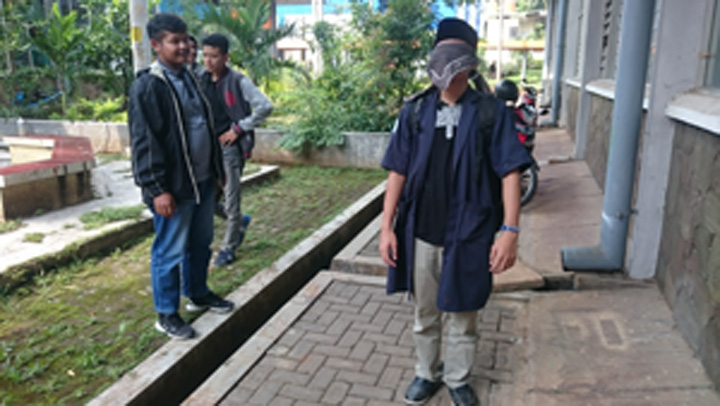
Three Semarang State Polytechnic (Polines) students introduced a Qibla direction tool for the blind. The team consisting of Fajar Kurniawan (Electrical Engineering), Riadlotul Itqoh (Electrical Engineering) and...
Three Semarang State Polytechnic (Polines) students introduced a Qibla direction tool for the blind. The team consisting of Fajar Kurniawan (Electrical Engineering), Riadlotul Itqoh (Electrical Engineering) and Febi Nur Chusnaeni (Accounting) is part of a Student Creativity Program (PKM) team. The creation of this PKM was motivated by their concern about the condition of blind people who often have difficulty determining the direction of the Qibla. They made a new breakthrough in the form of a peci which can show where the Qibla is.
Chaired by Fajar Kurniawan, the team created a simple tool that can be easily used by users. The design of this tool was later given the name Qibla Direction Peci for the Blind with Sound Output or what could be called PERAK GATRA.
Fajar admitted that the idea came to him when he was in a place where at that time he had quite difficulty in determining the direction of the Qibla. Of course, this also happens to most people, especially blind people. From there arose the desire to create a tool that could make it easier to determine the direction of the Qibla.
This tool uses a compass sensor inserted into the cap and an Arduino nano as the data processor. The sound that is produced consists of eight cardinal directions and one sound that sounds when we are facing the Qibla. This sound can be heard using a spiral headset so that only the user can hear it. This sound output was selected to support visually impaired conditions. The components inserted into the peci are relatively thin. The components are placed in strategic areas so that they do not disturb the user and the peci remains comfortable to use.
Trials were carried out on 10 participants and produced a good level of accuracy. Rizki, one of the participants, explained that the sound emitted by the peci sounded very clear, comfortable, and did not interfere during worship. Another participant also said this, "This peci is very useful, especially for the blind and the elderly so that they will no longer feel anxious due to errors in determining the direction of the Qibla," said Sirot.
Fajar added that the tools he had made so far had shown the expected progress.
"Thank God, the results of initial trials on 10 normal people who were blindfolded produced an accuracy value of 99% regarding the original angle of the Qibla direction," he concluded.